
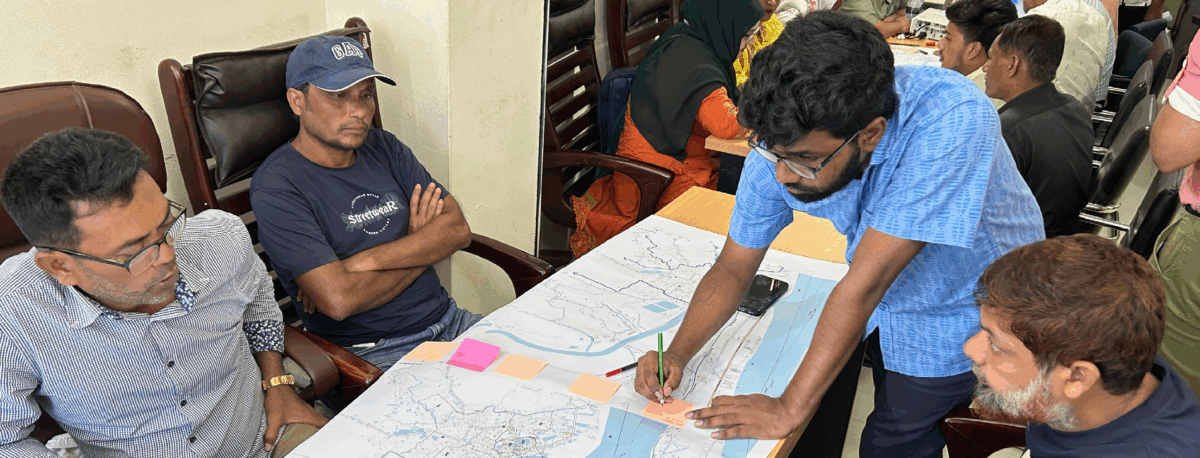
The Department of Architecture at Brac University, in collaboration with Sustainedge, organised five Focus Group Discussions (FGDs) and a stakeholder consultation workshop from 21 to 22 September 2025 at Mongla Port Municipality to engage local communities.
In total, 58 participants joined these sessions, comprising 11 women, 12 men, 11 girls, 12 boys, and 12 residents from informal settlements. The consultation also brought together municipal officials, NGOs, and community representatives to validate and prioritise issues. These activities are part of the research project “Urban Design Guidelines to Develop Climate Resilient and Inclusive Built Environment for Mongla Port Municipality, Bagerhat District, Bangladesh”, funded by the Research Seed Grant Initiative (RSGI) 2024 of Brac University.
The FGDs highlighted diverse yet interconnected community concerns. Women participants stressed the urgent need for safe shelters, reliable drinking water, improved sanitation, and inclusive public spaces where their safety and dignity are ensured. Youth groups drew attention to education disruptions during floods and cyclones, the lack of safe recreational spaces, and mobility challenges during extreme weather conditions, while also expressing their eagerness to volunteer in resilience-building initiatives. Market vendors and transport operators described the economic toll of waterlogging and salinity, noting that livelihoods, particularly shrimp farming, are being severely affected, with fishers struggling to maintain production due to both climate impacts and viral infections in shrimp.
Elderly residents spoke of health and mobility challenges, particularly the difficulty of accessing toilets, clinics, and public spaces during extreme weather, underscoring the need for age-friendly infrastructure and stronger support systems. Meanwhile, residents of informal settlements identified raised housing, improved drainage, and community awareness programmes as essential measures to safeguard lives and assets, emphasising that without inclusive facilities, their neighbourhoods risk being further marginalised in municipal planning.
The stakeholder consultation built on these insights, asking participants to identify their top climate-related challenges, the design improvements most urgently required, and priority locations for intervention. From this exercise, wards 1, 4, 5, 7, and 9 were identified as the most climate-vulnerable, facing severe waterlogging, water scarcity, and salinity intrusion. Participants also suggested practical interventions, including raised toilets, shaded walkways, water kiosks, and solar-powered facilities. Meanwhile, municipal leaders and NGOs emphasised the importance of collaboration in sustaining long-term resilience.
Situated in a climate-vulnerable coastal belt, Mongla Port Municipality has long been recognised as a climate change hotspot, exposed to recurrent cyclones, flooding, salinity intrusion, and inadequate urban infrastructure. This research seeks to bridge community knowledge with technical assessments and vulnerability mapping to inform climate-sensitive and inclusive urban design guidelines.
The next phase will focus on drafting these guidelines, which will be validated with stakeholders later in 2025. The process aims not only to develop technical solutions but also to embed community priorities at the heart of urban design, contributing to a more sustainable and resilient future for coastal cities in Bangladesh.